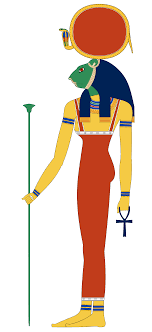
TYPE: Goddess of war
ORIGIN: Egyptian
KNOWN PERIOD OF WORSHIP: Circa 3000 BCE until the end of Egyptian history circa 400 CE.
SYNONYMS: Sachmet; possibly Sesmetet.
CENTER(S) OF CULT: Heliopolis, Memphis and other sanctuaries along the Nile valley.
ART REFERENCES: Sculptures, particularly at Karnak from sixteenth century BCE onward; wall paintings, royal tombs at Thebes, etc.
LITERARY SOURCES: coffin texts, royal tombs at Thebes, etc.
INFORMATION: Sakhmet is a significant deity int eh Egyptian New Kingdom at Memphis. Her father is the sun god Re and she is the consort of Ptah. She is, by implication, the mother of hte god of the primordial lotus blossom, Nefertum. In iconography Sakhmet is generally depicted in human form, but with the head of a lioness surmounted by a sun disc. Occasionally she is drawn with a rosette pattern over each breast (see Istar).
Sakhmet is, to an extent, syncretized with the goddess Mut, who is the consort of the sun god of Thebes, Amun. In the Karnak complex large numbers of Sakhmet's statues, typically hewn in black granite and in which she holds the ankh symbol of life or a papyrus stem, were raised in the precinct of the Mut sanctuary.
She is said to breathe fire against the enemies of the Pharaoh and, like Hathor in her attempt to destroy the human race, she can be the vengeful "eye of Re". She is sometimes linked with Hathor who is described as the "Mistress of the house of Sakhmet". In a more benign aspect, Sakhmet is a guardian goddess against disease.